
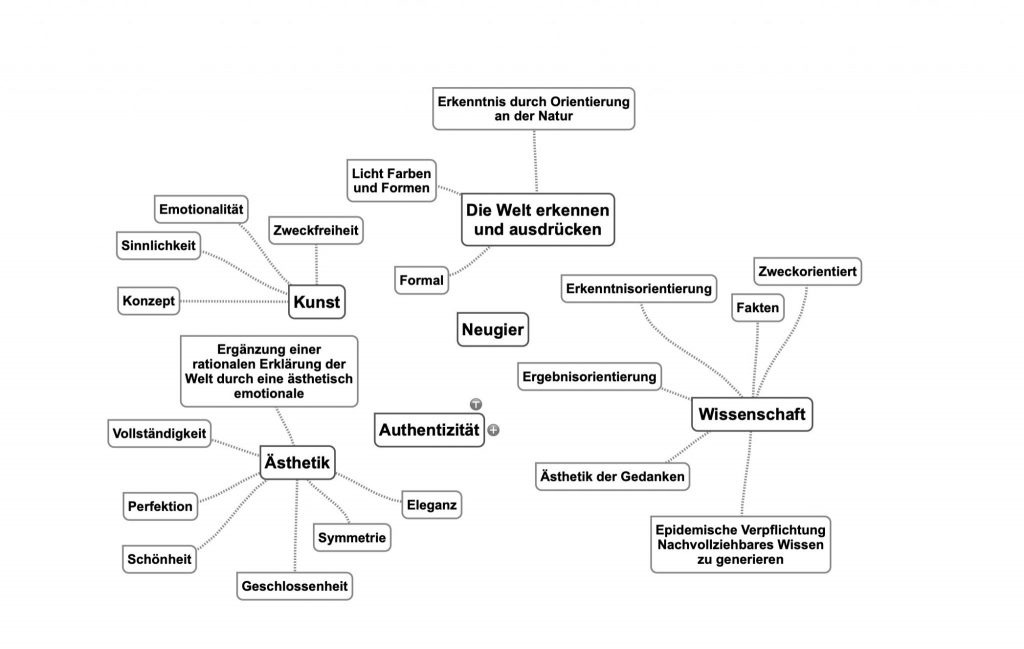
The starting point for this mind map was a series of conversations with scientists. We wanted to know what drives them: Why do they conduct research? What sparks their curiosity? And what motivates a person to make science their life’s path?
We contrasted these answers with our own experiences as artists. What drives us? Why do we engage in artistic work? What are we seeking in the image, in the material, in the process?
From these conversations, we identified key concepts and ideas. We organized them, established connections, and gradually let a network emerge. The goal was not so much to draw a line between art and science as it was to make their connections visible.
We worked on this network until only a few concepts remained that were not connected to others. Particularly interesting were those concepts that could not be clearly assigned to either science or art. Some—such as aesthetics—even developed their own network of relationships.
It was precisely here that a surprisingly large area of overlap became apparent: curiosity, the thirst for knowledge, imagination, experimentation, doubt, observation, and the search for connections clearly do not belong exclusively to art or science.
We worked on this network until only a few terms remained that were not connected to others. The terms that could not be clearly assigned to either science or art proved particularly interesting. Some—such as aesthetics—even developed their own network of relationships.
It was precisely here that a surprisingly large area of overlap became apparent: curiosity, the thirst for knowledge, imagination, experimentation, doubt, observation, and the search for connections are clearly not exclusive to either art or science.
Perhaps their methods and results differ. But their starting point is often astonishingly similar: the desire to discover, understand, and make visible something that was not visible before.